
A more flexible workshop, a more sustainable surface treatment process, and tools for assessing carbon footprints… the industry of tomorrow is already here as evidenced by our new selection of studies and market analyses conducted by Cetim – extract from The Cetim infos magazine, #280.
1/ Robots and artificial intelligence are reshaping the workshop
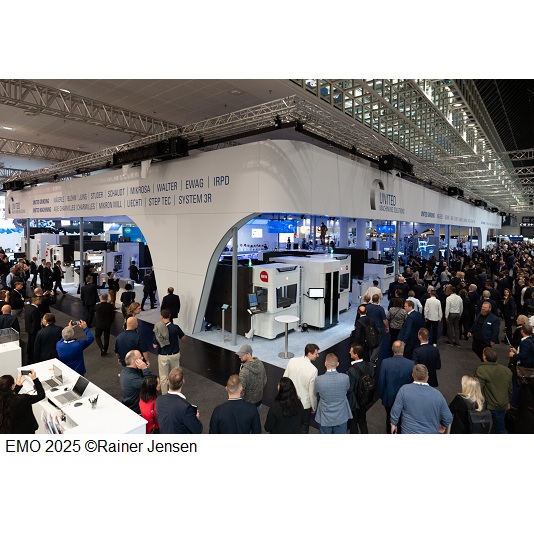
Seen at EMO 2025 by our technology watch experts, the workshop of the future is equipping itself with more flexible production resources, combined with digital tools designed to strengthen process reliability and support the evolving role of the operator. The demonstrations showcased machining robots capable of performing certain roughing and light finishing operations that were previously carried out by traditional machining centers. The objective here is not to compete with machine tools in terms of ultimate precision, but to offer more modular solutions capable of covering large working envelopes and integrating into reconfigurable production cells.
This development is illustrated in particular by Danobat’s DBot S7, equipped with dual encoders and controlled by a numerical command, as well as by Fanuc machining robots used for drilling or milling operations.
In parallel, Artificial Intelligence (AI) is establishing itself as a transversal assistance layer, integrated into support tools that operators can directly use. Whether in the form of programming copilots (such as those from Siemens, Heidenhain, or found in CAM environments) or assistants dedicated to diagnostics and maintenance, AI aims to secure machine settings and ensure reliable operation.
In a context marked by persistent skills shortages, these tools support the emergence of “augmented operators,” capable of gaining autonomy more quickly while maintaining a high level of process mastery throughout the entire production cycle.
2/ “Dry on Dry”: simplifying powder coating without multiplying baking cycles
The Dry on Dry process consists of successively applying a primer followed by a powder topcoat onto a conductive part, without any intermediate gelification or curing step, before a single pass through the oven.
The Cetim’s Performances series publication “Dry on Dry Powder Coating” (9Q538), produced as part of our R&D activities within the “Surface Treatment and Environment” project, shows that, depending on the configuration, operating costs can be reduced by 5 to 35%, mainly thanks to increased productivity and lower energy consumption at the oven level.
Whereas in the traditional process each layer requires a temperature rise between 160 and 220 °C for 10 to 20 minutes, the Dry on Dry method eliminates this intermediate stage, shortens process cycles, and reduces production line footprint.
This publication, based on Cetim’s R&D work, presents characterization tests carried out on sample plates and standard parts, compared with a primer + topcoat system applied with an incomplete intermediate bake. Microscopic observations and tests conducted according to a high‑durability C4 system (NF T 34‑560) show comparable performance in accelerated corrosion resistance, humidity resistance, gloss and adhesion. Beyond 1,500 hours of salt‑spray exposure, the results of the Dry on Dry process are slightly lower.
Finally, implementing the Dry on Dry process remains demanding: parts must have simple geometries, the number of available colors is limited, application must be automated, and primer/topcoat pairs must be specifically compatible. The stability of the process relies in particular on selecting matte or satin finishes, using paints that limit degassing, and precisely adjusting application parameters.
3/ Evaluating the carbon footprint of handling equipment
How can the carbon footprint of a handling or lifting machine be accurately assessed when regulatory requirements are multiplying and methods are overlapping?
Our technology watch note “Greenhouse Gas Assessment Tools and the Emergence of Associated Standards” provides industry stakeholders with guidance on best practices for better assessing and reducing the carbon footprint of their equipment, while complying with current and upcoming regulatory obligations.
The presentation of existing methodologies distinguishes between the Product Carbon Footprint (PCF) and Life Cycle Assessment (LCA), two complementary approaches focused on evaluating the carbon footprint of products. This comparison clarifies the scopes covered, the indicators used, and the potential applications depending on the objective (comparison of technical solutions, design support, etc.).
The document also offers a mapping of the main international normative references (ISO 14040/44, ISO 14067, EN 16796, ISO 14083) and European reporting frameworks (ESRS/CSRD), which provide consistent methodological foundations ensuring the comparability and reliability of results.
In addition to comparative tables and a literature review, representative industrial case studies illustrate how evaluation tools are concretely implemented to analyze technological or energy-related choices and identify opportunities for reducing the carbon footprint at the product level.